Introduction
Bull and bear statues are among the most recognizable symbols in the world of finance and investment. Often displayed in financial districts, stock exchanges, corporate offices, and public spaces, these animal sculptures represent the constant battle between two opposing market forces: bull markets and bear markets.
A bull statue symbolizes strength, confidence, growth, and optimism, reflecting periods when financial markets are rising. In contrast, a bear statue represents caution, decline, uncertainty, and market downturns. Together, bull and bear sculptures capture the dynamic nature of global economies and the ongoing balance between opportunity and risk.
Beyond their financial symbolism, these sculptures have also become powerful works of public art, representing ambition, resilience, and the human desire to overcome challenges. From the famous Wall Street Charging Bull in New York City to paired bull and bear statues in European financial centers, these artworks continue to inspire investors, businesses, and visitors worldwide.
The Meaning Behind Bull and Bear Statues
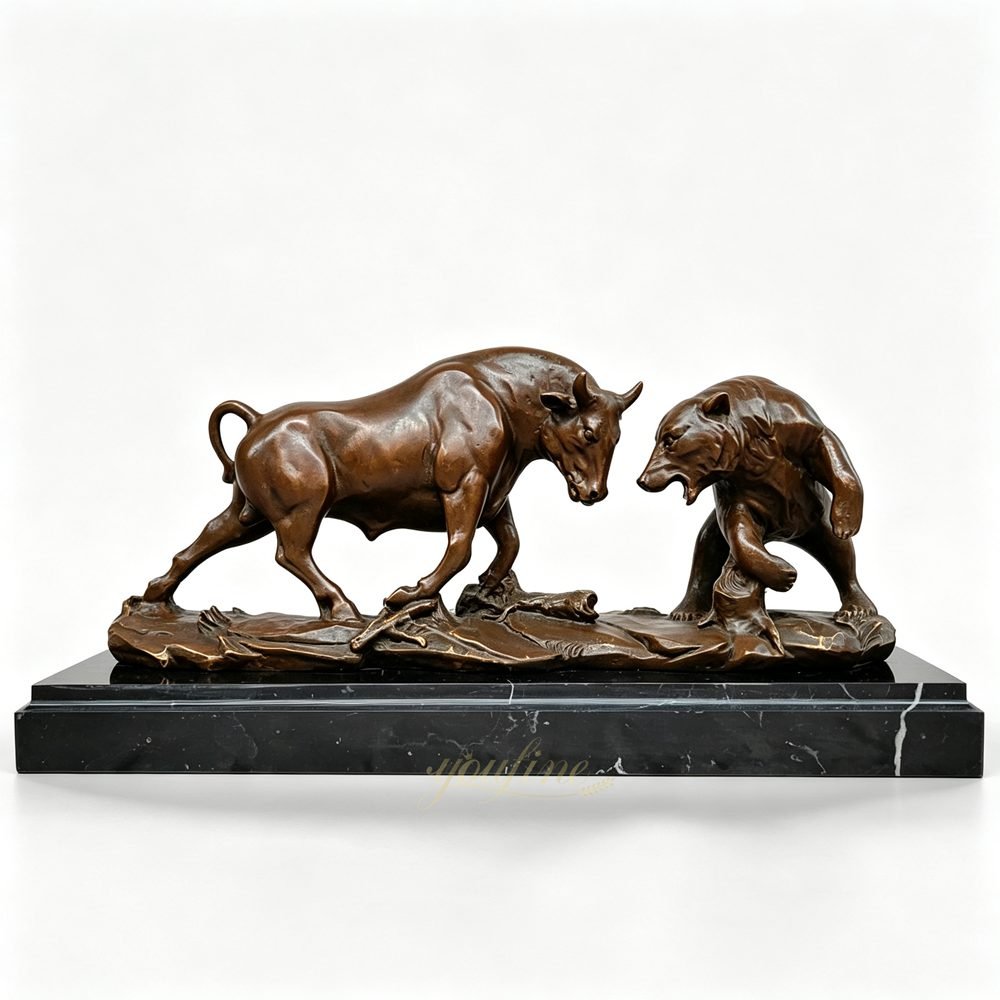
Bull and bear sculptures stand for the two counterbalancing powers of finance: growth-driven optimism and risk-minded caution, embodying the natural repeating cycle of economic expansion, downturn, and recovery.
Bull Statue Symbolism
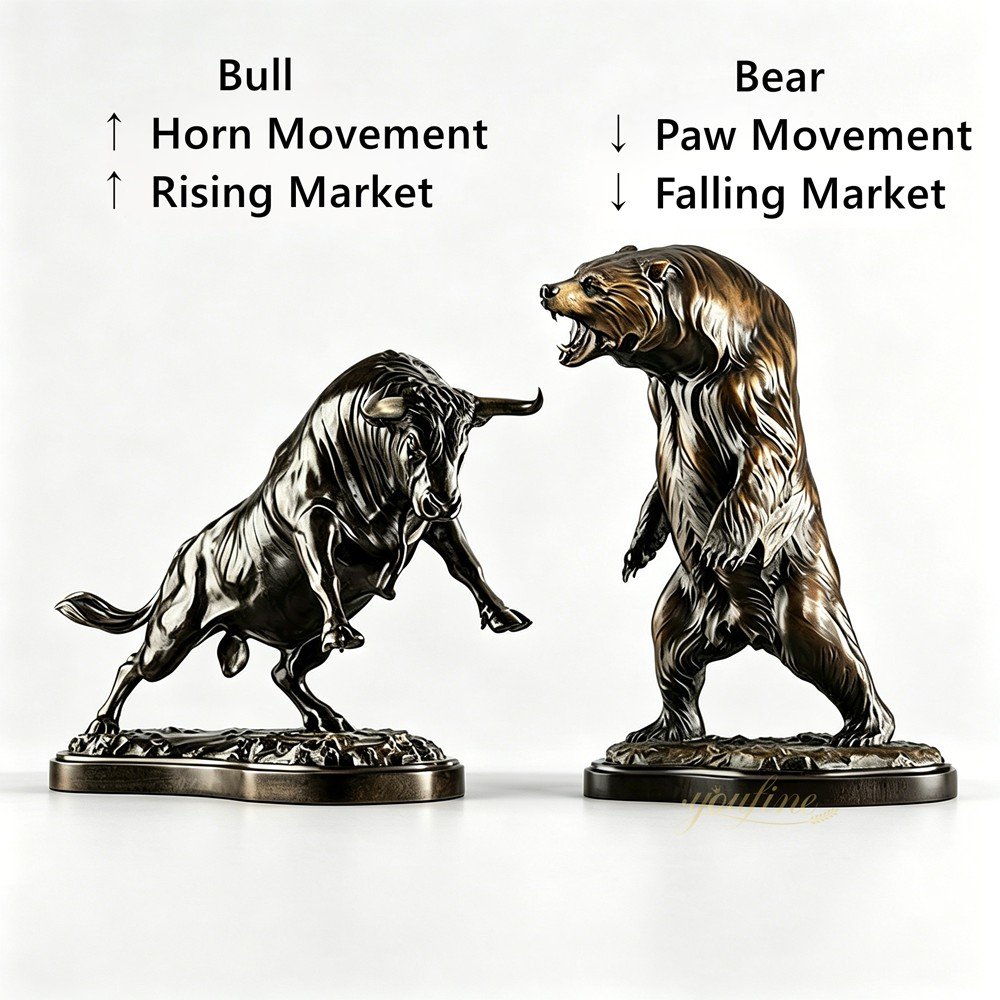
- The bull stands for strength, ambition, and upward momentum. Its upward horn thrust during a fight gave rise to the term “bull market”, a phase of rising asset prices and upbeat investor sentiment.
- It signifies business prosperity, promising opportunities, unwavering confidence, and resilience.
Bear Statue Symbolism
- The bear symbolizes prudence and market decline. Its downward-swiping paws inspired the definition of a “bear market”, marked by falling prices and conservative investment attitudes.
- It stands for economic uncertainty, risk awareness, rational judgment, and the adaptability needed to weather market slumps.
Joint Symbolism of Bull & Bear Paired Statues
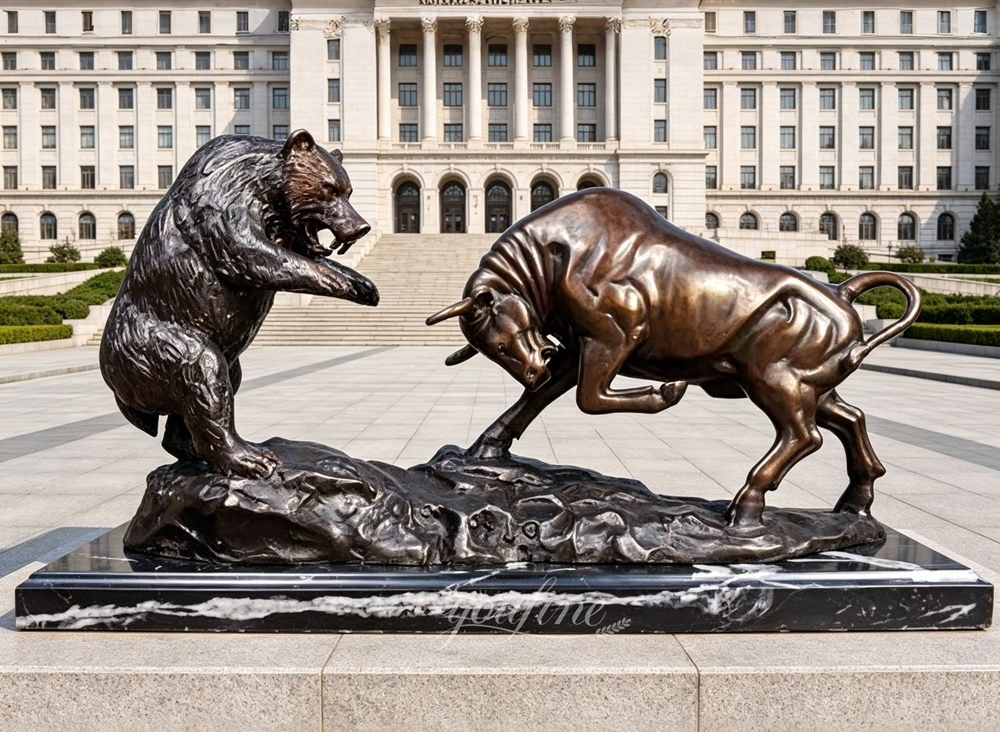
Displayed side by side, they illustrate the perpetual tug-of-war between rising and falling market forces.
Their pairing represents:
- The full natural cycle of economic shifts
- Constant competition between optimistic and risk-averse mindsets
- The value of balanced, strategic investing
Why Are Bulls and Bears Symbols of Financial Markets?
For centuries, bulls and bears have symbolized finance’s two opposite trends: rising and falling markets. The terms “bull market” and “bear market” became widely used in the 1700s, with four well-documented origins explaining this classic metaphor.
-
Animal Fighting Stance: The Most Widely Accepted Origin
This theory draws directly from each creature’s natural fighting movement:
The Bull: Upward Surge
A bull attacks by tossing its horns upward. This upward thrust became a natural symbol of rising stock prices, fueled by robust buyer confidence and expanding economic growth.
The Bear: Downward Decline
A bear strikes foes by swiping its heavy claws downwards. This downward motion mirrors falling market indexes triggered by mass panic selling.
-
The 18th-Century Bearskin Trader Origin
Etymologically, the term “bear” predated “bull” in financial jargon.
In 1700s England, speculative middlemen called “bearskin jobbers” would sell bear pelts they did not yet own. They gambled that the wholesale price of bear skins would fall later, letting them purchase the goods cheaply to pocket the price gap.
This high-risk short-selling practice spawned the classic proverb: “Don’t sell the bear’s skin before you’ve caught the bear.” Gradually, traders labeled these pessimistic speculators “bears”—a label still used today for investors betting on market downturns.
-
London’s Historic Bull and Bear Baiting Blood Sports
These animal fights flourished under Queen Elizabeth I in the 16th century and stayed popular into the 1700s. Elizabeth loved the sport, hosting grand bear-and-bull-baiting events for nobles and diplomats; royal backing made it a top public pastime across London.
To locals, bulls and bears represented unyielding rivals locked in brutal combat. London stock traders later borrowed this familiar rivalry as a metaphor for the endless clash between bullish buyers and bearish short-sellers in the market.
-
Contemporary Psychological Symbolism
In modern finance, the bull and bear carry deeper meaning beyond simple price movement, embodying two contrasting investor mindsets:
The bull embodies bold confidence, unstoppable momentum, and thriving economic prosperity.
The bear stands for prudence, self-preservation, hibernation-style restraint, and risk-averse caution.
The Evolution of Bull and Bear Statues
The journey of Bull and Bear statues is a fascinating story of cultural transformation. What started as ancient symbols of myth and nature evolved into 18th-century trading metaphors, before finally becoming the iconic bronze landmarks that define modern financial capitals today.
-
Ancient Times: Symbols of Power & Nature
Long before Wall Street, bulls represented wealth, strength, and prosperity in ancient mythologies. Bears symbolized natural force, endurance, and winter hibernation.
-
The 18th Century: Early Trading Metaphors
During London’s early stock market era, traders and satirical artists began using the bull and bear to represent market buyers and short-sellers. Brokers even kept small metal bull and bear figurines on their desks as symbols of market sentiment.
-
1989: The Iconic Charging Bull
After the 1987 stock market crash, sculptor Arturo Di Modica installed the massive 3.2-ton bronze Charging Bull on Wall Street as a secret gift. It quickly became a global symbol of financial strength, hope, and resilience.
-
Today: The Ultimate Market Rivalry
Modern financial hubs worldwide—like the Frankfurt Stock Exchange—now feature dynamic “Bull vs. Bear” bronze sculptures. They showcase the violent, ongoing tug-of-war between buyers and sellers that drives the global economy.
Famous Bull and Bear Sculptures Around the World
Around the world, iconic financial districts and stock exchanges display dynamic bronze Bull and Bear statues to reflect their economic power and market philosophy. From Wall Street to Frankfurt and Shanghai, these masterworks—crafted by world-renowned sculptors—capture the eternal balance, tension, and optimism of global capital markets.
-
The Charging Bull (Wall Street, New York)
- Location: Bowling Green, Financial District, New York City
- Artist: Arturo Di Modica
- Date: Installed in December 1989
- Specs: Bronze; 11 ft (3.4 m) tall, 16 ft (4.9 m) long; Weighs 3.2 tons (7,100 lbs)
- Meaning: Financial Power, Economic Resilience, and Unstoppable Optimism.
- Why it matters: Secretly installed under the cover of night as a Christmas gift after the 1987 stock crash, this massive bronze bull depicts a roaring beast leaning back on its haunches, horns up, ready to strike—making it the ultimate global landmark of market prosperity.
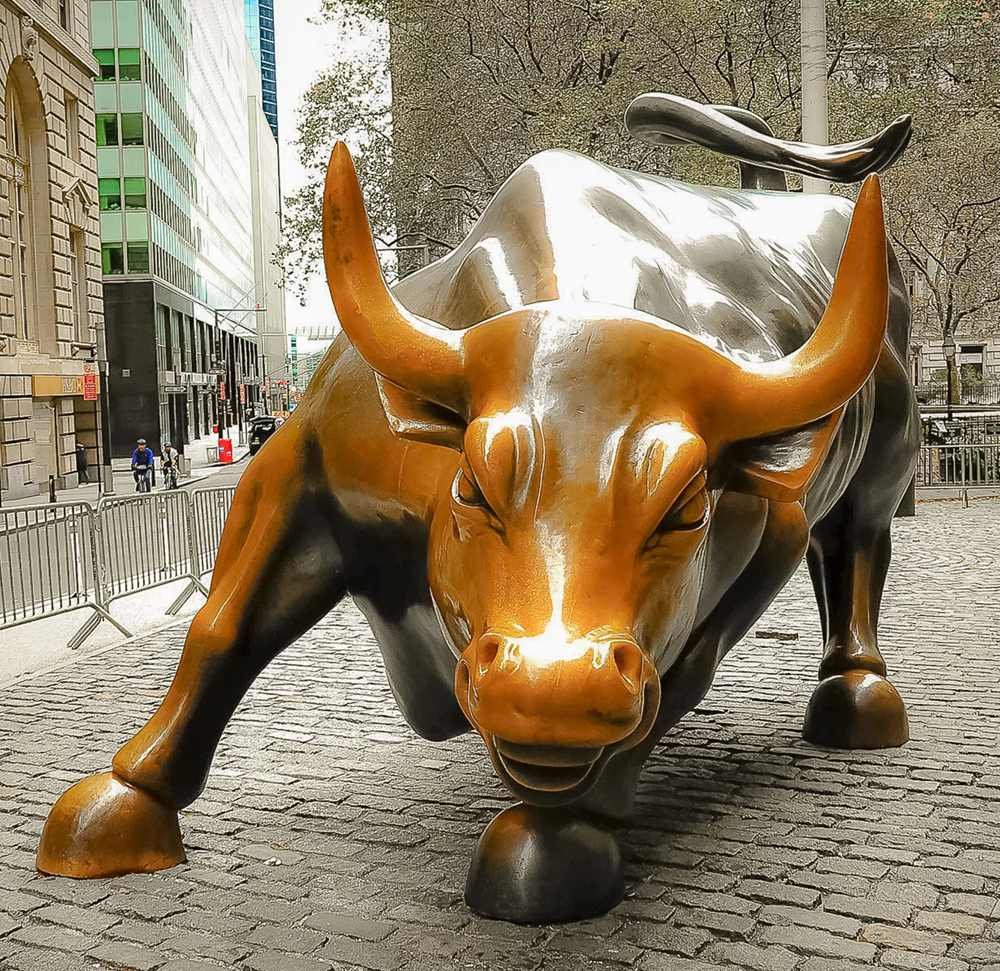
A 3.2-ton bronze sculpture created by Italian artist Arturo Di Modica in 1989. It is permanently installed at Bowling Green Park in the Financial District of Manhattan, New York. If you want to get the same item, you could click on the Famous New York Wall Street Bronze Bull Statue.
-
The Bund Financial Bull (Shanghai, China)
- Location: The Bund Financial Square, Shanghai
- Artist: Arturo Di Modica
- Date: Unveiled in April 2010
- Specs: Red-tinted Bronze; 8.2 ft (2.5 m) tall, 17 ft (5.2 m) long; Weighs 2.5 tons (5,500 lbs)
- Meaning: Growth, Youthful Energy, and the Vitality of Asian Markets.
- Why it matters: Commissioned by Shanghai’s financial authorities and sculpted by the same master behind Wall Street’s bull, the Bund Bull features a dynamic, twisting pose with its head lowered and tail pointed skyward, symbolizing China’s rising economic strength.
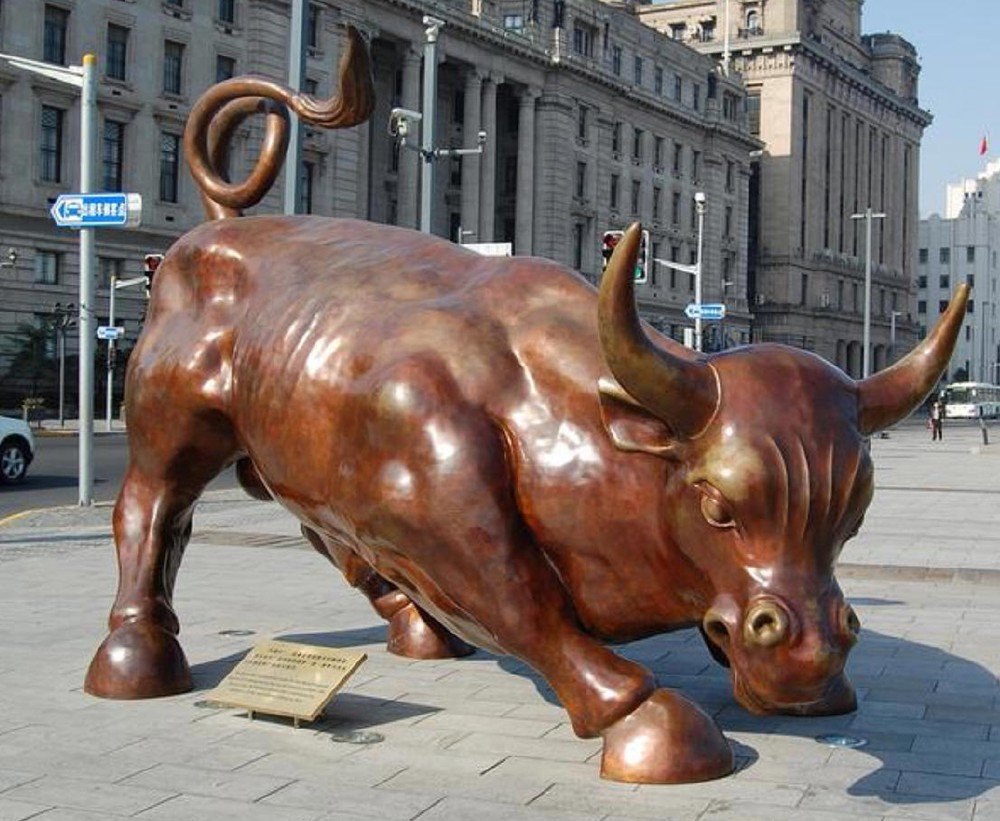
A large bronze bull sculpture created by artist Arturo Di Modica and unveiled in 2010. It is located on the Bund Financial Square in Shanghai, China.
-
Frankfurt Stock Exchange Bull and Bear (Frankfurt, Germany)
- Location: Börsenplatz, Frankfurt am Main
- Artist: Reinhard Dachlauer
- Date: Unveiled in 1985 (Centenary of the Exchange’s modern building)
- Specs: Life-sized Bronze Sculptures
- Meaning: The Eternal Conflict and Balance Between Buyers and Sellers.
- Why it matters: Located right outside the Frankfurt Stock Exchange, this pair is the definitive “Bull vs. Bear” monument. The fierce, muscle-bound bull faces off directly against the heavy, towering bear, capturing the constant price discovery and market equilibrium.
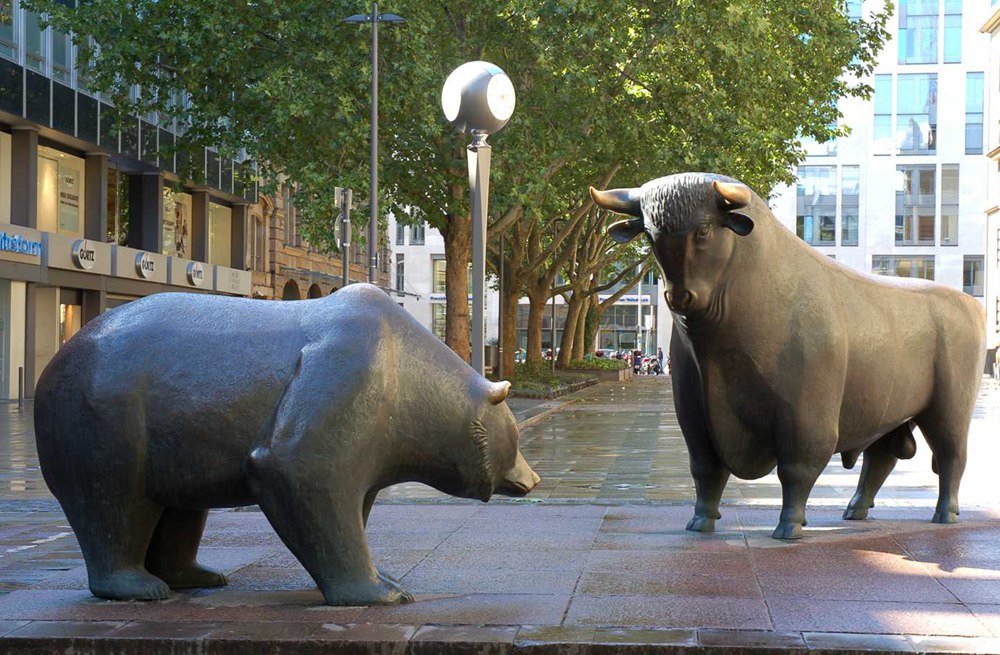
A pair of life-sized bronze bull and bear statues created by sculptor Reinhard Dachlauer in 1985. They stand at Börsenplatz directly outside the Frankfurt Stock Exchange.
-
Hong Kong Exchange Square Water Buffaloes (Hong Kong)
- Location: Exchange Square Plaza, Central, Hong Kong
- Artist: Dame Elisabeth Frink
- Date: Installed in 1988
- Specs: Bronze Pair; Life-sized
- Meaning: Resilience, Earthy Strength, and Asian Financial Heritage.
- Why it matters: Positioned outside the Hong Kong Stock Exchange, these two statues depart from Western tradition by depicting Asian Water Buffaloes—one resting and one standing—symbolizing long-term patience, hardworking effort, and sustainable prosperity.
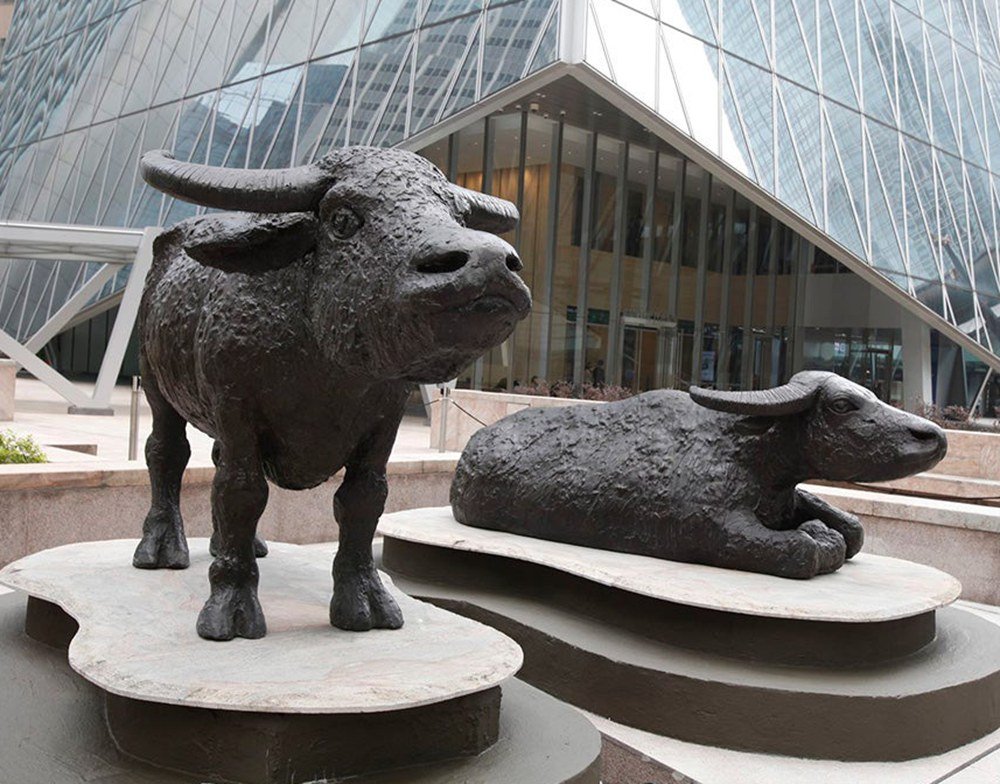
Two bronze water buffalo sculptures created by British artist Dame Elisabeth Frink in 1988. They are located at Exchange Square Plaza in Central, Hong Kong.
-
Stifel “Bull vs. Bear” Monument (St. Louis, USA)
- Location: Stifel Financial Corp Headquarters, St. Louis, Missouri
- Artist: Victor Issa
- Date: Unveiled in 2012
- Specs: Cast Bronze on a Natural Granite Base; Monumental Scale
- Meaning: High-Stakes Competition, Risk Management, and Market Friction.
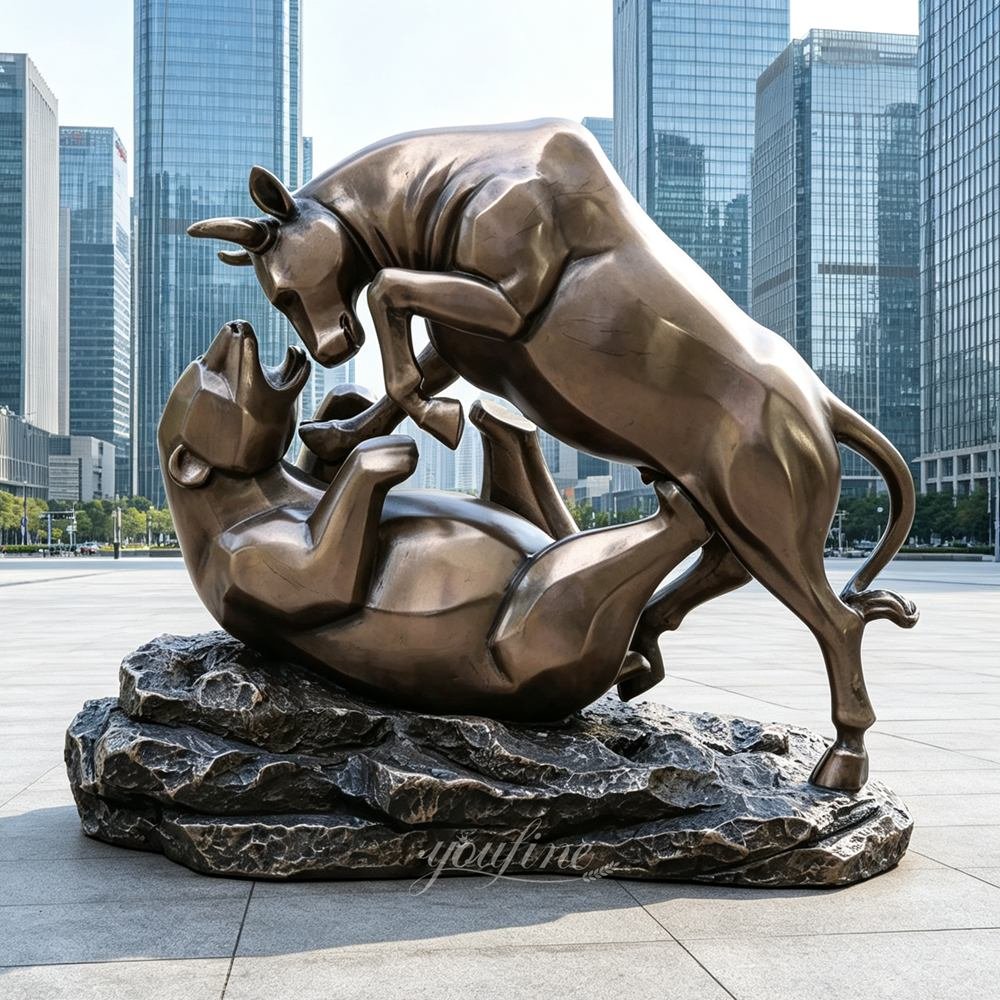
- Why it matters: This high-action bronze sculpture features a roaring bear locking horns mid-air with an aggressive charging bull, dramatically illustrating the high-stakes collision between risk and reward in financial markets.
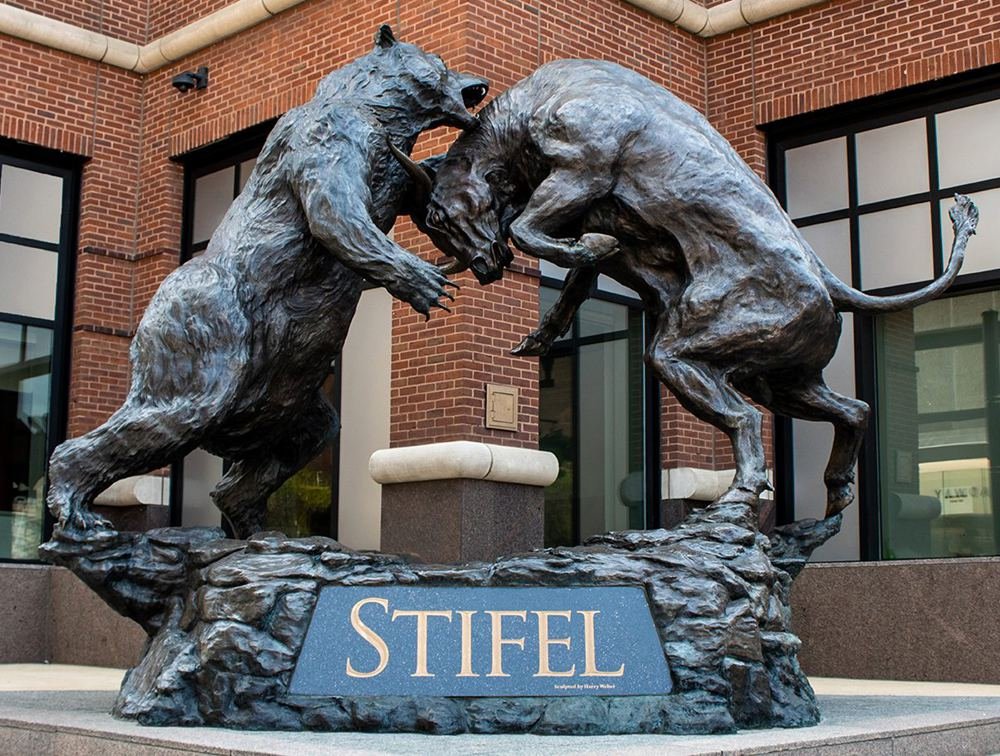
A bronze sculpture of a bull and bear in combat, created by sculptor Harry Weber. It is installed on a granite base outside the Stifel Financial Corp headquarters in St. Louis, Missouri. If you want to get the same item, you could click on the bronze bull and bear statue.
-
Moscow City Roller-Skating Bull & Bear (Moscow, Russia)
- Location: Moscow International Business Center (Moscow-City)
- Artist: Contemporary Commission (Cifra Bank)
- Date: Installed in the 2020s
- Specs: Cast Bronze with Dark Patina; Life-sized
- Meaning: Market Speed, Agility, and Fast-Moving Capital.
- Why it matters: Located outside Cifra Bank, this whimsical, contemporary installation adds a modern spin to trading tradition by outfitting both the bull and the bear with roller skates—metaphorically highlighting how rapidly market sentiment rolls back and forth.
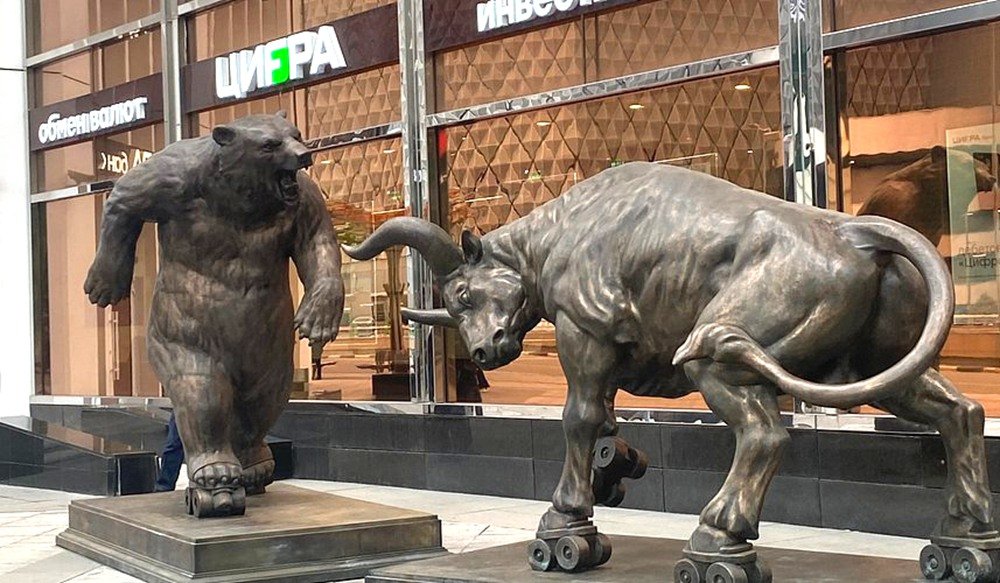
A contemporary bronze installation depicting a bull and a bear wearing roller skates. It is situated outside Cifra Bank in the Moscow International Business Center.
Where Are Bull and Bear Statues Commonly Installed?
Bull and bear statues are often installed in locations connected with finance, business, and public culture. Because these sculptures symbolize strength, prosperity, market confidence, and economic cycles, they are commonly chosen for places where their powerful message can be seen by employees, visitors, and the public.
- Financial Districts and Stock Market Centers
Financial districts are the most traditional locations for bull and bear statues because these sculptures directly represent market trends and investor psychology.
They are commonly placed near:
- Stock exchanges
- Banking institutions
- Investment companies
- Financial landmarks
In these locations, bull and bear sculptures represent the constant movement of financial markets and the competition between optimism and caution.
- Corporate Offices and Business Headquarters
Many companies install bull or bear sculptures at their headquarters, entrances, or reception areas to communicate values such as:
- Growth and ambition
- Business strength
- Long-term vision
- Market confidence
A customized bull and bear statue can also become a unique brand symbol, especially for financial firms, investment companies, and businesses related to wealth management.
- Public Spaces and Cultural Landmarks
Beyond finance-related locations, bull and bear statues are also used as public artworks in plazas, parks, and commercial areas.
In these settings, the sculptures focus less on market symbolism and more on:
- Creating memorable city landmarks
- Attracting visitors
- Enhancing public spaces
- Expressing themes of strength and perseverance
Many cities use animal sculptures like bulls and bears as recognizable cultural symbols that connect art, history, and local identity.
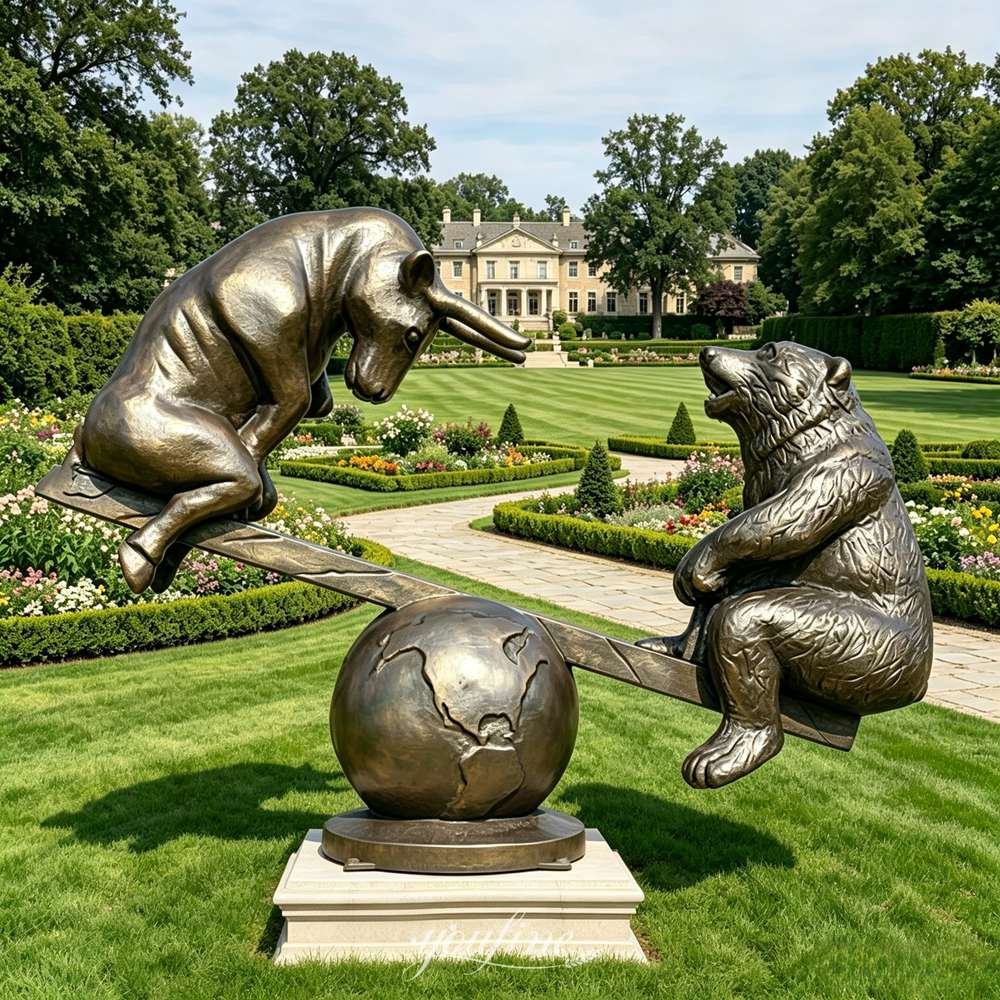
- Private Collections and Luxury Properties
Bull and bear sculptures are also popular choices for:
- Luxury homes
- Private gardens
- Estates
- Clubs
- Interior decoration projects
In private spaces, they are often appreciated not only for their financial symbolism but also for their powerful appearance and artistic value.
How to Choose a High-Quality Bull and Bear Statue?
A well-crafted bull and bear statue is not only a decorative artwork but also a long-term investment. Whether used for a financial institution, corporate space, garden, or public project, several factors should be considered.
- Select the Right Material
The material affects the statue’s appearance, durability, and maintenance requirements.
Common choices include:
| Material | Features |
|---|---|
| Bronze | Classic appearance, excellent durability, suitable for outdoor sculptures |
| Stainless Steel | Modern look, corrosion resistance, suitable for contemporary spaces |
| Marble | Elegant appearance, ideal for luxury environments and indoor decoration |
For large outdoor bull and bear statues, bronze is one of the most popular choices because of its strength and timeless appearance.
- Consider Size and Installation Location
The size of the sculpture should match the surrounding environment.
Consider:
- Available space
- Viewing distance
- Indoor or outdoor installation
- Landscape design
- Foundation requirements
A large bull statue can become a landmark centerpiece, while smaller sculptures may work better in offices or private collections.
- Pay Attention to Craftsmanship
A high-quality bull and bear statue should have:
- Realistic animal detail
- Detailed muscle and texture carving
- Smooth surface finishing
- Stable structure
- Professional making techniques
The expression and movement of the sculpture are especially important because they communicate the power and emotion behind the symbolism.
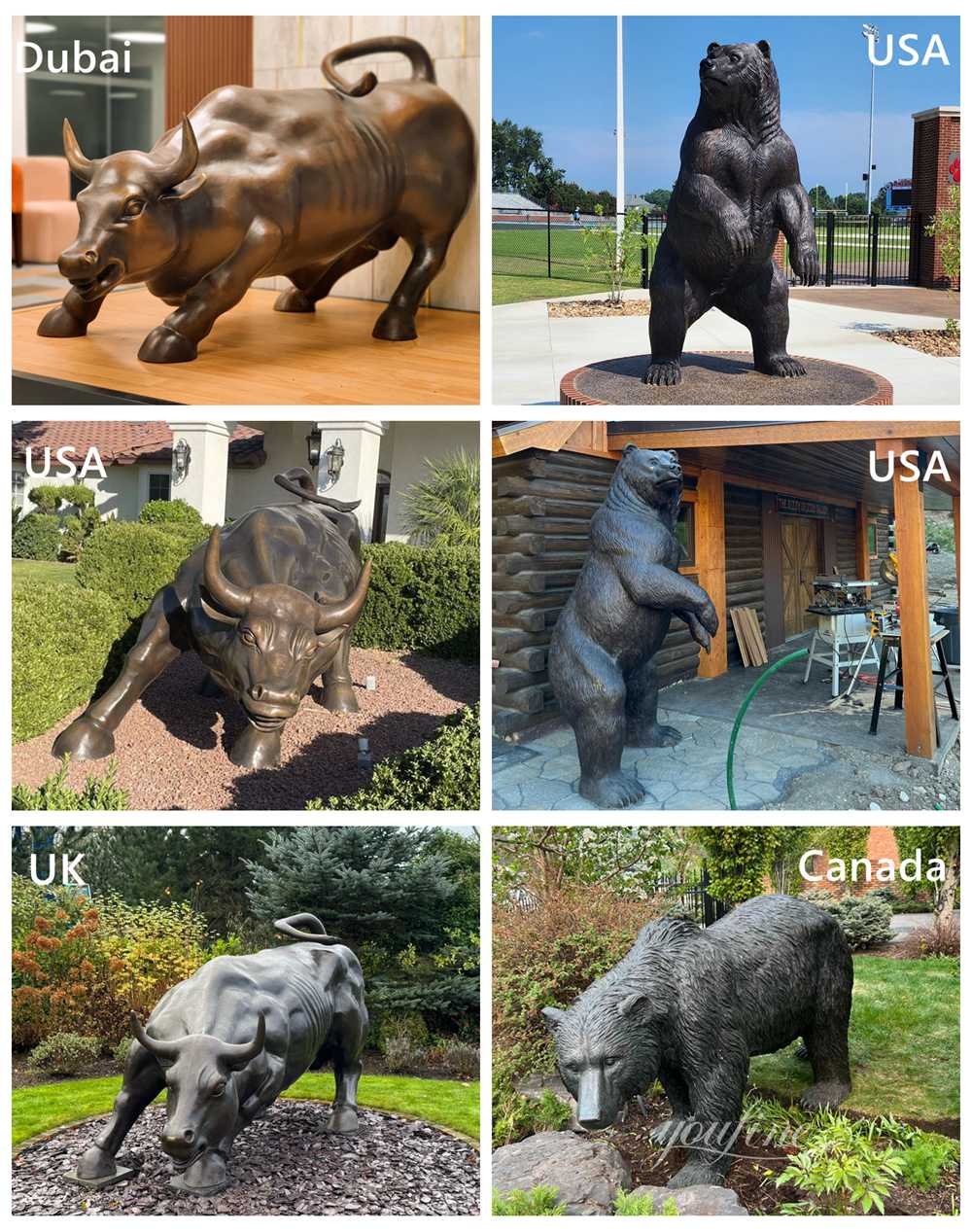
- Customization Options
Professional sculpture manufacturers can customize bull and bear statues according to project needs, including:
- Custom sizes
- Different poses and designs
- Surface finishes
- Logos or decorative elements
- Special bases and installation solutions
Custom-made sculptures allow businesses and organizations to create unique artworks that match their brand identity.
Final Thoughts
Bull and bear statues are more than decorative sculptures; they are powerful symbols of financial markets, economic cycles, and human ambition. The bull represents growth, confidence, and prosperity, while the bear represents caution, challenges, and resilience.
From Wall Street’s famous Charging Bull to financial landmarks around the world, these sculptures continue to remind people that markets are shaped by both optimism and uncertainty. Whether displayed in a financial district, corporate headquarters, or public space, a bull and bear statue represents the ongoing balance between opportunity and challenge.
If you would also like to add a finely crafted bull and bear sculpture or a unique custom-designed sculpture to your space, please contact us directly. We offer factory-direct sales backed by over 40 years of sculpting experience, working with materials such as marble, bronze, and stainless steel, and provide fast global shipping.