From ancient temples and imperial monuments to Renaissance masterpieces and modern national icons, relief sculptures have preserved myths, beliefs, political ideals, and collective memory for thousands of years. Below are 12 of the most famous relief sculptures around the world, each representing a milestone in artistic, cultural, and historical development.
-
Gates of Paradise
Florence, Italy | Lorenzo Ghiberti
Date: 1425–1452
Historical Background: Commissioned for the east doors of the Florence Baptistery during the Italian Renaissance, these doors were created by Lorenzo Ghiberti after he won a celebrated competition among leading sculptors.
Description: Cast in gilded bronze, the doors consist of ten panels depicting scenes from the Old Testament. Ghiberti employed low relief (rilievo schiacciato) and linear perspective to create remarkable depth and spatial realism.
Location: Florence Baptistery (originals preserved in Museo dell’Opera del Duomo)
Influence & Significance: Michelangelo famously called them the “Gates of Paradise.” They mark a turning point in Renaissance sculpture, merging classical harmony with narrative clarity and technical innovation.

-
Ishtar Gate
Babylon (modern-day Iraq) / Pergamon Museum, Berlin
Date: c. 575 BCE (Neo-Babylonian period)
Historical Background: Built under King Nebuchadnezzar II, the Ishtar Gate served as a ceremonial entrance to the ancient city of Babylon.
Description: The city gate was constructed from glazed blue bricks and adorned with bas-relief patterns, including lions, dragons (Mushhushshu), and bulls. The lion symbolized the goddess Ishtar, representing power and protection; the bull symbolized the desire for favorable weather and abundant harvests; and the dragon was the guardian deity of Babylon, representing divine power.
Location: Reconstructed sections are housed in the Pergamon Museum, Berlin
Influence & Significance: The Ishtar Gate demonstrates how relief sculpture was integrated with architecture and color, influencing later monumental gateways in the ancient world.

-
Parthenon Marbles
Athens, Greece / British Museum, London
Date: c. 447–432 BCE
Historical Background: Created during the height of Classical Athens under Pericles, these reliefs once adorned the Parthenon temple on the Acropolis.
Description: The sculptural works include friezes, metopes, and pedimental sculptures carved in high relief, depicting scenes such as mythological battles and the Panathenaic procession, with the drapery of the figures flowing like water.
Location: British Museum (with remaining pieces in Athens)
Influence & Significance: The Parthenon Marbles set the classical standard for proportion, movement, and idealized human anatomy, shaping Western art for centuries.

-
Mount Rushmore
South Dakota, USA
Date: 1927–1941
Historical Background: Designed by sculptor Gutzon Borglum to commemorate the founding spirit of the United States.
Description: The colossal high-relief carving depicts the faces of four U.S. presidents—George Washington, Thomas Jefferson, Theodore Roosevelt, and Abraham Lincoln—carved directly into granite.Magnificent and imposing.
Location: Black Hills, South Dakota
Influence & Significance: Mount Rushmore represents modern large-scale relief carving and demonstrates how relief sculpture can function as a national symbol. However, it has also drawn criticism for neglecting Indigenous history, becoming a cultural landmark embroiled in “historical narrative controversies.”

-
Borobudur Temple Reliefs
Java, Indonesia
Date: 8th–9th century CE
Historical Background: Borobudur is the world’s largest Buddhist temple, built under the Sailendra dynasty.
Description: Over 2,600 relief panels illustrate Buddhist cosmology, moral teachings, and the life of the Buddha. The reliefs combine narrative clarity with rhythmic composition.
Location: Borobudur, Central Java
Influence & Significance: These reliefs function as a visual scripture, guiding pilgrims spiritually while representing one of the most extensive relief cycles in world history. Also known as a textbook of Southeast Asian Buddhist art.

-
Bayon Temple Reliefs
Angkor, Cambodia
Date: Late 12th–early 13th century
Historical Background: Built during the reign of King Jayavarman VII, the Bayon Temple is a key monument of the Khmer Empire.
Description: The bas-reliefs depict military campaigns, naval battles, marketplaces, and everyday life, carved with lively realism.
Location: Angkor Thom, Cambodia
Influence & Significance: Unlike purely mythological reliefs, Bayon’s carvings offer rare insight into daily life and society in medieval Southeast Asia.

-
Karnak Temple Reliefs
Luxor, Egypt
Date: c. 2000–1000 BCE
Historical Background: Karnak was developed over many dynasties and served as a major religious center dedicated to Amun-Ra.
Description: The walls feature extensive sunken reliefs, ideal for Egypt’s strong sunlight, depicting rituals, offerings, and military victories.
Location: Karnak Temple Complex, Egypt
Influence & Significance: Karnak’s reliefs exemplify the symbolic and hierarchical visual language of ancient Egyptian art. It is referred to as a “stone chronicle” for the study of ancient Egyptian politics and beliefs.

-
The Descent of the Ganges (Arjuna’s Penance)
Mahabalipuram, India
Date: 7th century CE
Historical Background: This relief sculpture was created to commemorate Narasimhavarman I’s victory over Pulakeshin II, the emperor of the Chalukya dynasty.
Description: It is carved from two massive, exposed rocks, measuring 96 feet by 43 feet (29 meters by 13 meters). The relief depicts the legend of the sacred Ganges River descending from heaven to earth under the guidance of Bhagiratha.
The Descent of the Ganges relief employs a combination of high and low relief techniques, rendering the figures of people and animals with remarkable realism.
Location: Mahabalipuram, Tamil Nadu
Influence & Significance: This monumental relief sculpture, the most stunning in the history of Indian art, blends nature and mythology and is hailed as an “epic in stone.”

-
La Marseillaise
Paris, France | François Rude
Date: 1833–1836
Historical Background: Created during the post-Revolutionary period, this relief decorates the Arc de Triomphe.
Description: A dramatic high-relief allegory showing the spirit of Liberty leading French citizens into battle. The Statue of Liberty, holding a sword and raising her arm in a triumphant gesture, leads soldiers, craftsmen, farmers, and people from different social classes. The figures are depicted in dynamic and spirited poses.
Location: Arc de Triomphe, Paris
Influence & Significance: This La Marseillaise sculpture relief serves as both a commemoration of the French Revolution and a celebration of the spirit of liberty, equality, and fraternity; it is a prime example of the integration of Romantic sculpture and public commemorative architecture.

-
Great Altar of Pergamon
Pergamon (modern Turkey) / Berlin
Date: 2nd century BCE
Historical Background: Combining religious and political significance, it ostensibly celebrates “the victory of the Olympian gods over the giants” (the Gigantomachy), but in reality, it metaphorically represents the Kingdom of Pergamon’s victory over the Gauls, consolidating its independence and showcasing the dynasty’s authority and the superiority of Greek civilization.
Description: The monumental frieze depicts the Gigantomachy, carved in deeply undercut high relief with intense drama.
The giants are mostly depicted with human torsos and serpent legs, and the gods achieve victory by severing their connection to the ground.
The twelve Olympian gods, including Zeus and Apollo, fight in different areas, while the earth goddess Gaia pleads for her sons, and the goddess of victory crowns the victorious gods.
Location: Pergamon Museum, Berlin
Influence & Significance: The Pergamon altar influenced Roman relief sculpture and later Baroque dramatic expression.

-
Stone Mountain
Georgia, USA
Date: Carving began in 1915; completed in 1972
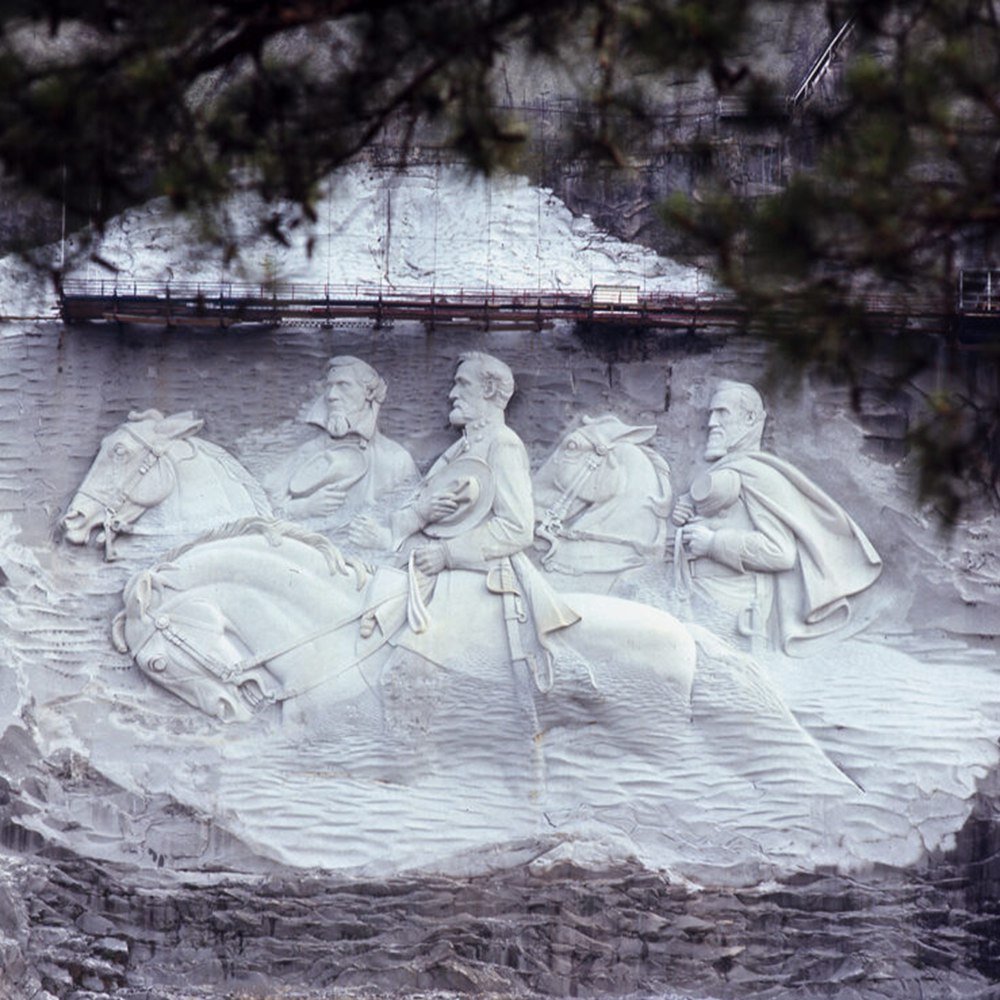
Historical Background: Intended as a Confederate memorial, the monument remains controversial.
Description: Carved into granite, it depicts three Confederate leaders (Jefferson Davis, Robert E. Lee, Stonewall Jackson) in massive high relief, making it the largest relief sculpture in the world.
The three figures ride side-by-side on warhorses in a solemn posture. Their expressions are dignified, and the lines of their robes and the muscularity of their horses are boldly and powerfully depicted. The background is devoid of superfluous decoration.
Location: Stone Mountain Park, Georgia
Influence & Significance: Artistically significant for scale and technique, the Confederate once upheld slavery, so this Stone Mountain sculpture has always been highly controversial.
-
Sarcophagus of Junius Bassus
Vatican City
Date: 359 CE
Historical Background: Created for a Roman official who converted to Christianity late in life.
Description: The marble bas-relief depicts scenes such as “The Baptism of Christ” and “The Last Supper,” blending Roman and Christian elements.
Location: Vatican Museums
Influence & Significance: This Sarcophagus of Junius Bassus is a key example of early Christian relief sculpture and the transition from pagan to Christian art.

Conclusion
These twelve famous relief sculptures span continents, different religions, and thousands of years of history, yet they all demonstrate the enduring power of relief art to convey faith, authority, and human experience. Whether carved on temple walls or mountainsides, relief art has consistently served as an important bridge between architecture, narrative, and sculpture, and continues to inspire artists and viewers to this day.