Among the world’s most famous sculptures, “The Gates of Paradise” and “The Gates of Hell” are often discussed together. Although both share the theme of “gates,” they were created in completely different artistic eras and represent opposed spiritual meanings and visual expressions.
This article will systematically compare these two classic sculptures across six key dimensions, helping you quickly understand their differences and value.
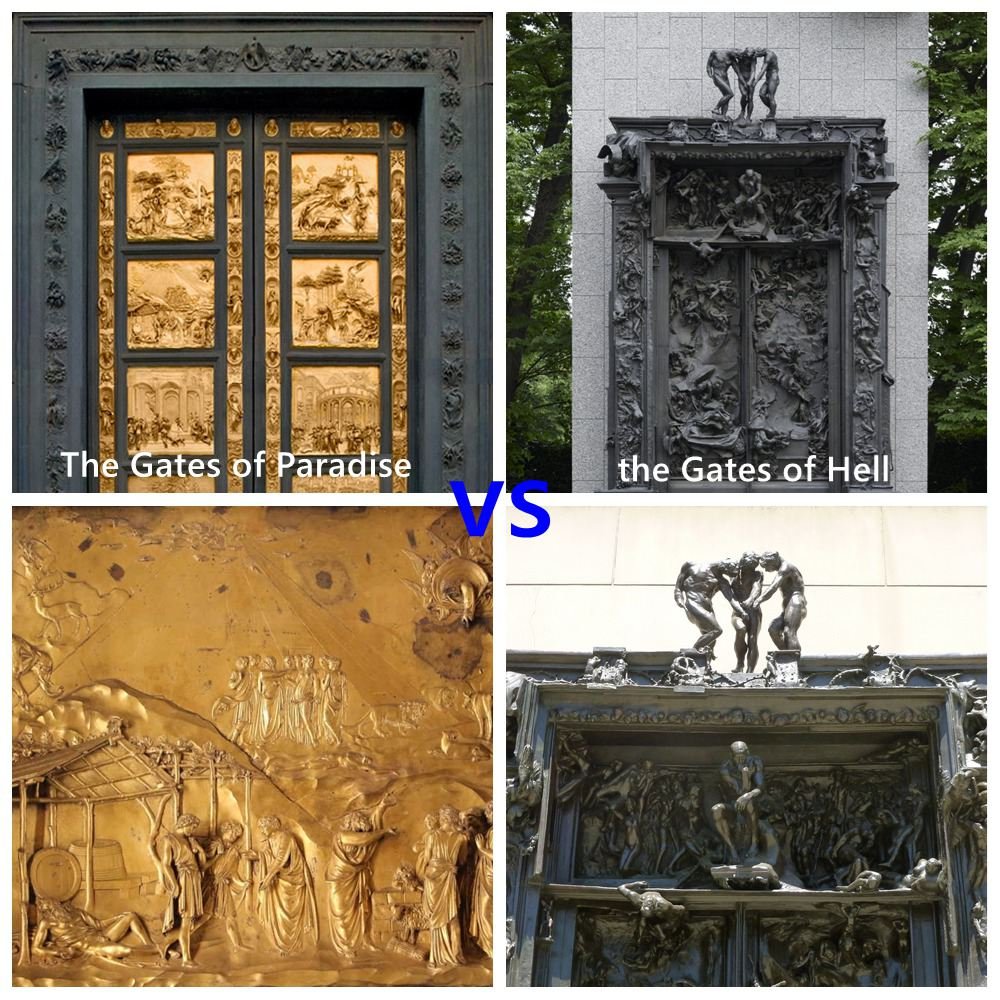
6 Key Differences Between the Gates of Paradise and the Gates of Hell
-
Artists and Creative Background
The Gates of Paradise
- Artist: Lorenzo Ghiberti (Italian)
- Creation Period: 15th century, early Renaissance, completed over 27 years (1425–1452)
- Creative Background: Bronze doors commissioned for the Florence Baptistery of St. John
- Reflects the Renaissance pursuit of reason, aesthetics, and religious order

The Gates of Hell
- Artist: Auguste Rodin (French)
- Creation Period: Late 19th century, commissioned by the French government in 1880, and still unfinished at the time of his death in 1917
- Creative Background: Inspired by Dante’s *Inferno*
- More focused on the artist’s personal expression, directly confronting the spiritual dilemmas and existential anxieties of modern people, rather than being an architectural appendage.

➡️ One serves a religious space, the other stems from artistic exploration.
-
Theme and Symbolic Meaning
| Aspect | Gates of Paradise | Gates of Hell |
|---|---|---|
| Core Theme | Salvation, faith, divine order | Suffering, desire, inner conflict |
| Emotional Tone | Calm, solemn, harmonious | Intense, dramatic, chaotic |
| Symbolism | The path to heaven | The consequences of human temptation |
The Gates of Paradise emphasize hope and redemption, while the Gates of Hell confront the darker side of human existence.

-
Sculpture Content and Detail Representation
Characteristics of the Gates of Paradise:
- Composed of 10 large relief panels
- Content is taken from the Old Testament, which includes core narratives such as creation and Abraham’s sacrifice, symbolizing the ladder of faith, divine order, and the hope of salvation.
- Uses a “picture frame” composition, with multiple scenes harmoniously coexisting on a single panel
- Employs perspective, resulting in clear layering
- Figures have harmonious proportions and restrained movements, reflecting the ideal beauty of “harmony between man and God.”

Characteristics of the Gates of Hell:
- Contains over 180 figures
- Figures have distorted postures and extremely strong emotional tension
- The composition is dense, with no fixed reading order
- “The Thinker,” “The Kiss,” and “The Three Shadows” are classic examples within it; “The Thinker” overlooks humanity, and “The Kiss” is an allegory of the tragedy of desire.

➡️ The former resembles an orderly religious narrative, while the latter is more like a visually impactful explosion of emotion.
-
Artistic Style and Forms of Expression
The Gates of Paradise
- Renaissance style
- Primarily low and medium relief
- Emphasizes proportion, space, and rational beauty

The Gates of Hell
- Modern sculptural style
- High relief, even approaching full-round sculpture
- Emphasizes bodily tension and emotional expression

It can be said that the Gates of Paradise represent the “pinnacle of classical art,” while the Gates of Hell opened the “door to modern sculpture.”
-
Materials and Craftsmanship
| Feature | Gates of Paradise | Gates of Hell |
|---|---|---|
| Common Material | Gilded bronze | Bronze |
| Surface Finish | Smooth and refined | Rough, textured |
| Technical Focus | Detail and perspective | Form, tension, atmosphere |
High-quality replicas of both works require advanced bronze casting techniques and precise proportion control.
-
Installation Location and Cultural Impact
The Gates of Paradise:
- Originally located on the east door of the Florence Baptistery of St. John, the original was moved to a museum in 1945 for preservation, and a replica was placed at the original site.
- It is hailed as a “manifesto of Renaissance sculpture,” directly influencing Donatello and Michelangelo, and becoming a symbol of the cultural soul of Florence.

The Gates of Hell:
- Due to the cancellation of the original project for the Musée des Arts Décoratifs in Paris, Rodin did not see the physical installation during his lifetime. Existing castings are distributed in various locations worldwide, including the Rodin Museum in Paris and Stanford University in the United States.
- It shattered classical sculptural paradigms, inspired Brancusi and Giacometti, and is widely considered the “birth certificate of modern sculpture.”

Gates of Paradise and Gates of Hell Replicas YouFine Can Provide
As a professional sculpture factory, YouFine has over 40 years of experience in sculpture production since its establishment in 1983. We can provide you with high-quality replicas of the Gates of Paradise and the Gates of Hell sculptures according to your needs:
- Accurate reproduction, perfectly replicating every detail of the sculptures.
- Supports custom sizes (proportionally scaled).
- A variety of high-quality materials and colors to choose from (bronze, marble).
- Suitable for churches, gardens, museums, and private collections.


Whether you want replicas of these two classic sculptures or specific elements from the sculptures, such as Rodin’s Kiss or The Thinker, you can contact us directly. Simply send us your preferred material and scene images, whether for life-size or large size, and we can meet your needs.
FAQ:
Who gave the Gates of Paradise their name?
The name “Gates of Paradise” was given by Michelangelo.
After seeing Lorenzo Ghiberti’s bronze doors for the Florence Baptistery, Michelangelo famously said they were “so beautiful that they would be worthy to be the gates of paradise,” and the name has been used ever since.
What do the Gates of Paradise represent?
The Gates of Paradise represent divine order, salvation, and the biblical path to heaven.
Through scenes from the Old Testament, the doors symbolize God’s plan for humanity, moral order, and the promise of redemption. Their balanced composition and calm figures reflect Renaissance ideals of harmony and faith.
What does the Gates of Hell sculpture represent?
The Gates of Hell represent human suffering, desire, punishment, and inner struggle.
Inspired by Dante’s Inferno, the sculpture explores the emotional and psychological state of humanity rather than offering religious instruction. It reflects themes of chaos, temptation, and existential anguish.
Why is the original “Gates of Paradise” located in a museum?
The original “Gates of Paradise” was severely damaged by the Florence flood of 1966. After restoration, to ensure the long-term preservation of this Renaissance masterpiece, it was moved to the Cathedral Museum for safekeeping, and a replica was placed in its original location.
Are both sculptures considered religious sculptures?
Not exactly. The Gates of Paradise is a true religious sculpture, created specifically for a church building and directly illustrating biblical stories.
The Gates of Hell, while inspired by religious literature, is better described as a philosophical and artistic sculpture, focusing on human emotion rather than formal religious worship.
What settings are replicas of these sculptures suitable for?
Gates of Paradise replicas are suitable for: Churches and religious institutions, museums, cultural centers, courtyards, cloisters, and formal gardens.
Gates of Hell replicas are suitable for: Museums and art institutions, public plazas and cultural spaces, private art collections, and sculpture gardens
Are they suitable for outdoor installation?
Yes, whether made of marble or bronze, these replicas are of excellent quality, durable, and suitable for long-term outdoor use.
How much do Gates of Paradise and Gates of Hell replicas cost?
Replica prices depend on size, material, level of detail, and installation requirements. Generally, marble Gates of Hell and Gates of Paradise, around 7.5 feet tall, are priced between $20,000 and $60,000 or more. Bronze versions may be even more expensive. For an accurate quote, please contact us directly.
Conclusion
“The Gates of Paradise” guides the steps of faith with the light of reason, while “The Gates of Hell” gazes into the abyss of humanity with eyes of compassion. They are not opposites, but rather two poles of the human spiritual spectrum—one gazing at the stars, the other confronting the abyss.
If you are looking for classic sculptures that combine cultural depth with strong visual impact, both of these “gates” are well worth exploring.