Baroque sculpture emerged in Europe in the early 17th century, closely associated with the Counter-Reformation, the rise of monarchies, and the spread of Catholic art. It sought to express intense emotions, capture dramatic moments, and create dynamic spatial compositions. This artistic language makes Baroque sculpture one of the most compelling sculptural styles in the history of Western art.
This article mainly introduces 10 of the world’s most famous Baroque sculptures and provides tips for quickly identifying Baroque sculptures, helping us to better understand the characteristics of this style of sculpture.
-
Aeneas, Anchises, and Ascanius
- Artist: Bernini
- Date: 1618–1619
- Location: Borghese Gallery, Rome
This is an early work, already showing the beginnings of the Baroque style. The poses of the three generations of figures progress in layers, expressing themes of responsibility, inheritance, and escape. Although not yet reaching the complexity of Bernini’s peak period, the dynamic composition is already very evident.

-
The Rape of Proserpina – Bernini
- Artist: Bernini
- Date of Creation: 1621–1622
- Location: Borghese Gallery, Rome
This work is renowned for its astonishing realistic detail: Pluto’s fingers press deeply into Proserpina’s body, the girl struggles and cries out, creating intense emotional tension. Through physical contact and contrasting expressions, Bernini vividly portrays violence, resistance, and helplessness, making it a classic example of the “emotional extremism” of Baroque sculpture.

-
David – Gian Lorenzo Bernini
- Artist: Bernini
- Date of Creation: 1623–1624
- Location: Borghese Gallery, Rome
Unlike Michelangelo’s static, contemplative *David*, Bernini chose the moment of action: David is twisting his body, intently throwing a stone. His muscles are tensed, his expression is strained, and the viewer can almost feel the conflict about to unfold. This “time-slice” representation is a typical characteristic of Baroque sculpture.

-
Apollo and Daphne – Bernini
- Artist: Bernini
- Date of Creation: 1622–1625
- Location: Borghese Gallery, Rome
This sculpture captures the most dramatic moment in the myth: Daphne is transforming into a laurel tree. Her fingers are turning into branches and leaves, her feet into roots; the transformation is incomplete but irreversible. The work emphasizes the process of transformation rather than the result, reflecting Baroque art’s fascination with “momentary change.”

-
Saint Longinus – Bernini
- Artist: Bernini
- Date: 1631–1638
- Location: St. Peter’s Basilica, Vatican City
Saint Longinus stretches out his arms and gazes at the sky, his body “struck” by the power of faith. Through exaggerated body language and flowing drapery, the sculpture depicts a moment of spiritual awakening, possessing immense religious impact.

-
Tomb of Pope Urban VIII – Bernini
- Artist: Bernini
- Date: 1635–1640
- Location: St. Peter’s Basilica, Vatican City
This tomb sculpture breaks away from the traditional solemnity of burial monuments. The Pope appears to be still speaking, while the skeleton, symbolizing death, is writing the inscription, creating a powerful dialogue between life and death. Here, Baroque sculpture not only serves a commemorative function but also takes on the role of religious and political symbolism.

-
Fountain of the Four Rivers – Bernini
- Artist: Bernini
- Date: 1648–1651
- Location: Piazza Navona, Rome
This is a Baroque masterpiece that integrates sculpture, architecture, and urban space. The four river gods symbolize the Nile, Danube, Ganges, and La Plata rivers, each with distinct postures and vivid expressions. The work is not only a sculpture but also a dramatic stage in a public space, reflecting the holistic thinking of Baroque art.

-
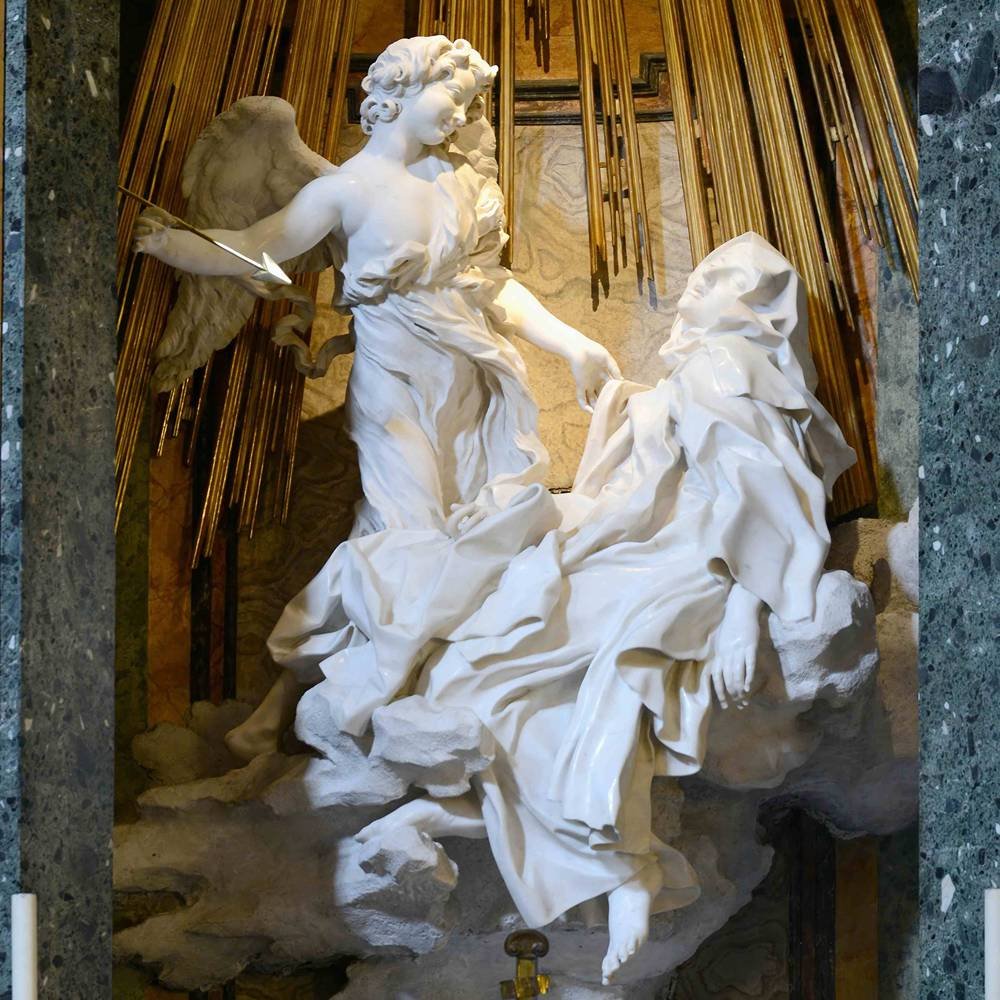
The Ecstasy of Saint Teresa – Bernini
- Artist: Bernini
- Date: 1647–1652
- Location: Santa Maria della Vittoria, Rome
This is one of the most famous works of Baroque religious sculpture. Saint Teresa is immersed in a mystical experience, her expression oscillating between pain and pleasure. Bernini cleverly combines sculpture, architecture, and light, transforming the entire space into a theater of religious emotion.
-
El Transparente
- Artist: Narciso Tomé and his four sons
- Date: 1721-1732
- Location: Toledo Cathedral, Spain
This altar is known for its complex structure and strong sense of visual focus, representing Baroque religious spatial art. Sculpture, architecture, and light work together to make the altar the central stage of the religious experience, embodying the Baroque art’s purpose of “awe-inspiring” the viewer.

- The Vision of Saint Bruno
- Artist: Michel-Ange Slodtz
- Date: 1744
- Location: St. Peter’s Basilica, Vatican City
The sculpture depicts Saint Bruno refusing the position of Archbishop of Canterbury, preferring the life of a hermit. On one side of the sculpture, a putto holds a bishop’s mitre, symbolizing Saint Bruno’s rejection of worldly honors.

How to Quickly Identify Baroque Sculptures?
Baroque sculptures can be quickly identified through four core characteristics:
- Observe the dynamism: Do they show exaggerated body contortions and capture fleeting moments of action?
For example, Bernini’s David shows the forceful posture of throwing a stone, and Apollo and Daphne depicts the moment of transformation, not a static, balanced pose.
- Observe the ornamentation: Are there intricate drapery, ornate bases, and natural elements (rocks, water, cherubs) as embellishments?
- Observe the emotion: Do they convey strong, dramatic emotions (such as ecstasy, anger, pain, etc.)?
- Observe the light and shadow: Do they utilize the concave and convex structures of the sculpture to create contrasts of light and shadow, enhancing the atmosphere?
If a sculpture meets 2-3 of these characteristics, it can generally be identified as Baroque in style.
Why is Baroque Sculpture Still Important Today?
Baroque sculpture transformed how people perceive sculpture. It ceased to be merely an “object to be viewed,” but became an artistic presence that engages with space, emotion, and narrative. This emphasis on experience and impact continues to influence the design principles of public sculpture, religious art, and monumental sculpture.
Timeline of Sculpture Art Development
Classical (5th century BC – 4th century BC) → Renaissance (14th century – 16th century) → Baroque (17th century – early 18th century) → Neoclassicism (mid-18th century – early 19th century)
- Classical: Rationality, Proportion, Restraint
- Renaissance: Humanism, Balance, Ideal Beauty
- Baroque: Dynamism, Drama, Intense Emotion
- Neoclassicism: Return to Order, Calmness, Classical Ideals
If you are interested in Baroque-style sculptures or other styles of sculpture reproductions, please feel free to contact us.
Factory direct sales, fast global shipping, and 40 years of high-quality guarantee.