Corten steel sculptures have become a favourite in gardens, parks, campuses and commercial outdoor landscapes. Their vintage rust finish changes naturally with sun and rain, bringing a warm sense of time with it — and it sits easily alongside everything from naturalistic planting to clean, modern design.
But when you are choosing one, it is easy to look only at the shape and overlook site fit, scale, craftsmanship and aftercare. Plenty of people only notice the problems after installation: a style that doesn’t sit right with the setting, a size that feels awkward, rust runoff staining the paving in the early months, corrosion near the coast, or a piece that warps over time.
You do not need years of experience to avoid this. Run through four things—site and environment, placement and size, style, and craftsmanship—and most common mistakes disappear. Site preparation and ongoing care are not really buying decisions, but they decide how easy the piece is to live with, so they are covered in the second section.

What to Look For: Four Factors That Matter Most
Site and Environment Fit: Choose the Right Setting, and It Lasts Twice as Long
Corten steel protects itself with a dense rust layer that forms slowly on the surface. That layer only knits together properly if the steel gets wet and then dries out fully, again and again. So the environment comes first.
Where it works well
- Inland campuses, city parks, private gardens and inland business parks. Wet-and-dry cycles are even and the air carries little salt, so the patina forms steadily and the piece looks better every year.
- Dry, low-rainfall regions. The patina forms slowly here, so choose a pre-rusted piece — the rusting was done before delivery, so local rainfall makes no difference.
Where it needs attention
- Damp, rainy inland sites. Focus on drainage and airflow around the base, and keep water from pooling, which speeds up corrosion in that one spot.
Where we would not recommend it
- Coastal settings. Chloride in sea air stops the protective rust layer from stabilising, and the piece may keep bleeding rust stains. It also ages far faster than inland. We would not use corten steel in waterfront or near-coastal locations — salt exposure is strongest within 800 m (about half a mile) of the shore, and still moderate to strong between 0.5 and 2 miles. Bronze or 316 stainless steel are the reliable choices there.
One note: opinions differ. IOTA in the UK considers corten suitable for all environments including coastal, while North American practice tends to be more conservative. We take the cautious view. For a full coastal material comparison, see our guide to coastal and seaside sculpture.
Placement and Size: Fitting the Space, Not Fighting It
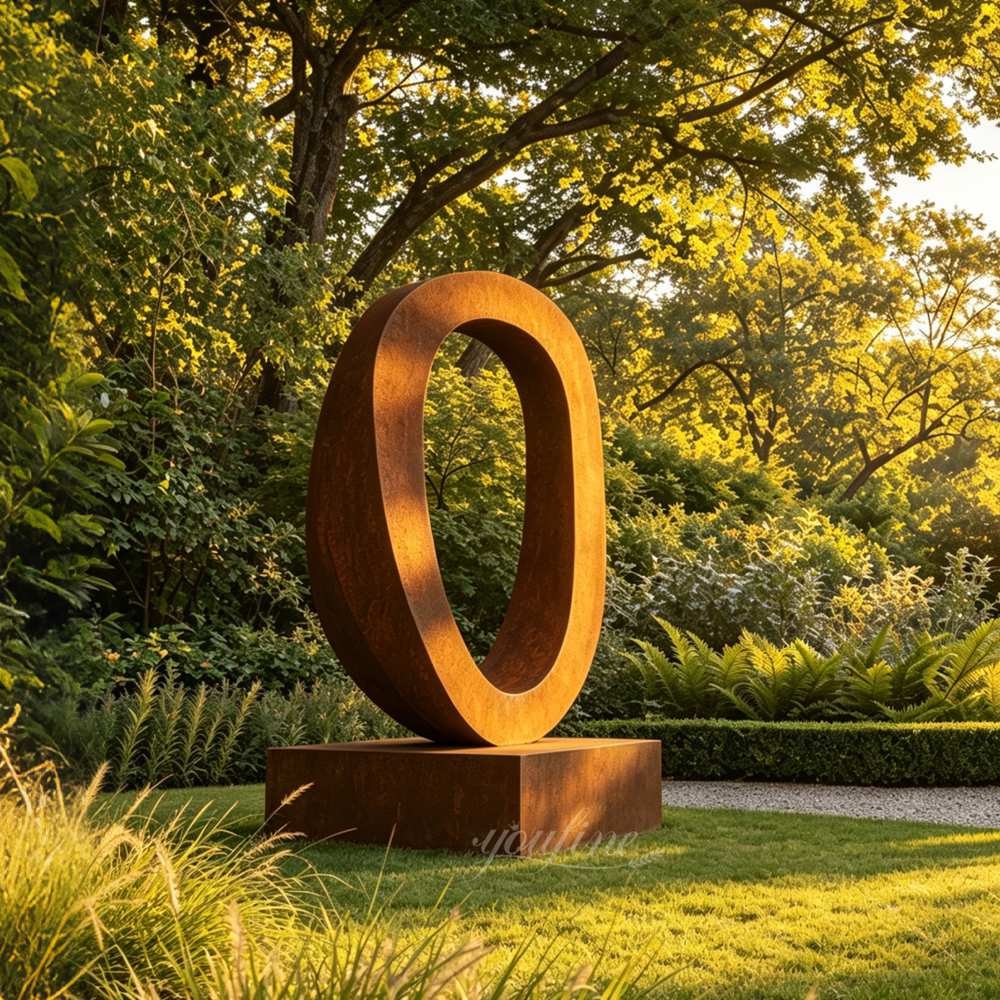
Too small and the piece looks thin and lost, with no sense of layering. Too large and it crowds the space and breaks the balance. Never judge size from a photo — work from the actual length and width of your site and from the viewing distance. These are the ranges we use when planning (a starting point, not an industry standard), listed from smallest to largest:
On viewing distance, a rough rule: the spot where you first see the piece should be about 2–3 times its height away. If the space is tight and you cannot step back that far, go down one size.

Style and Form: Matching the Landscape, Keeping Your Own Taste
There is a lot of choice, and different forms suit different landscapes. Weigh your own preference against the overall character of the site:
- Natural, organic forms — fruit, plants, animals, simple natural pieces. Soft shapes with a lived-in feel, warm and gently nostalgic. They suit English gardens, naturalistic planting and small private courtyards.
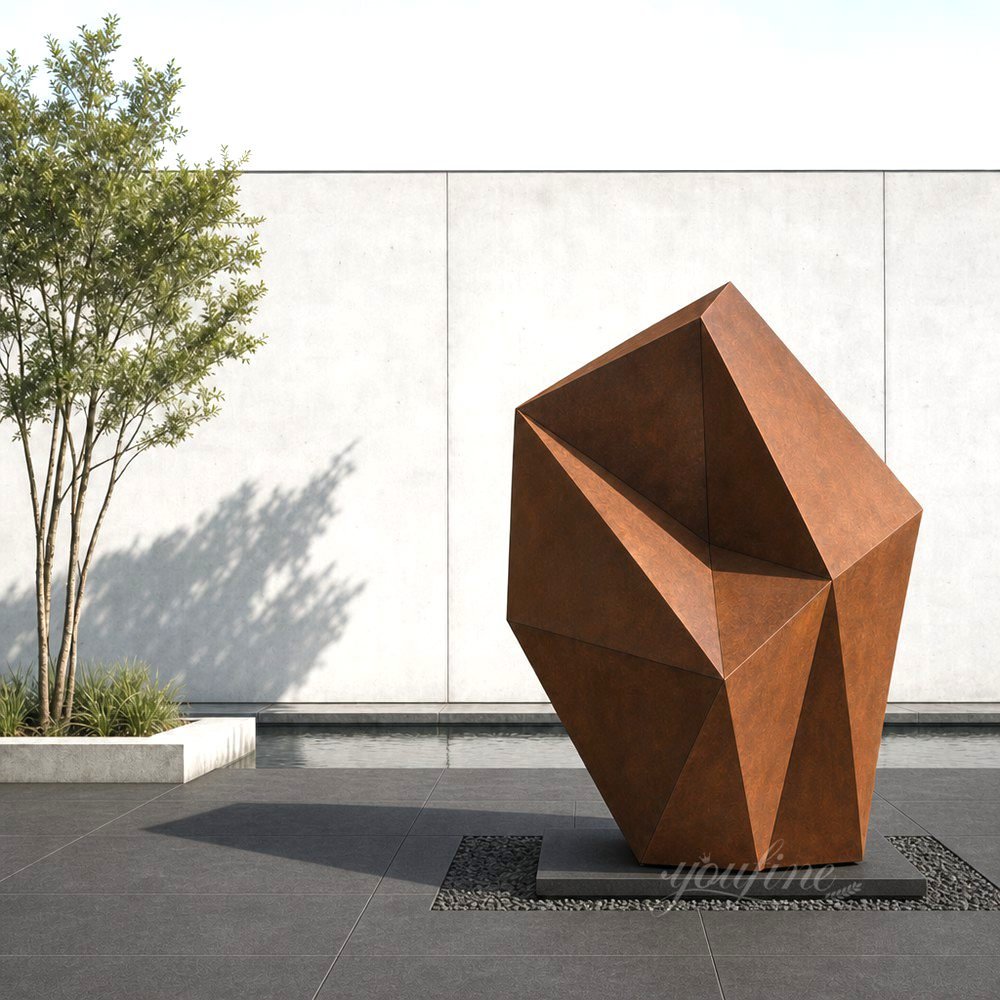
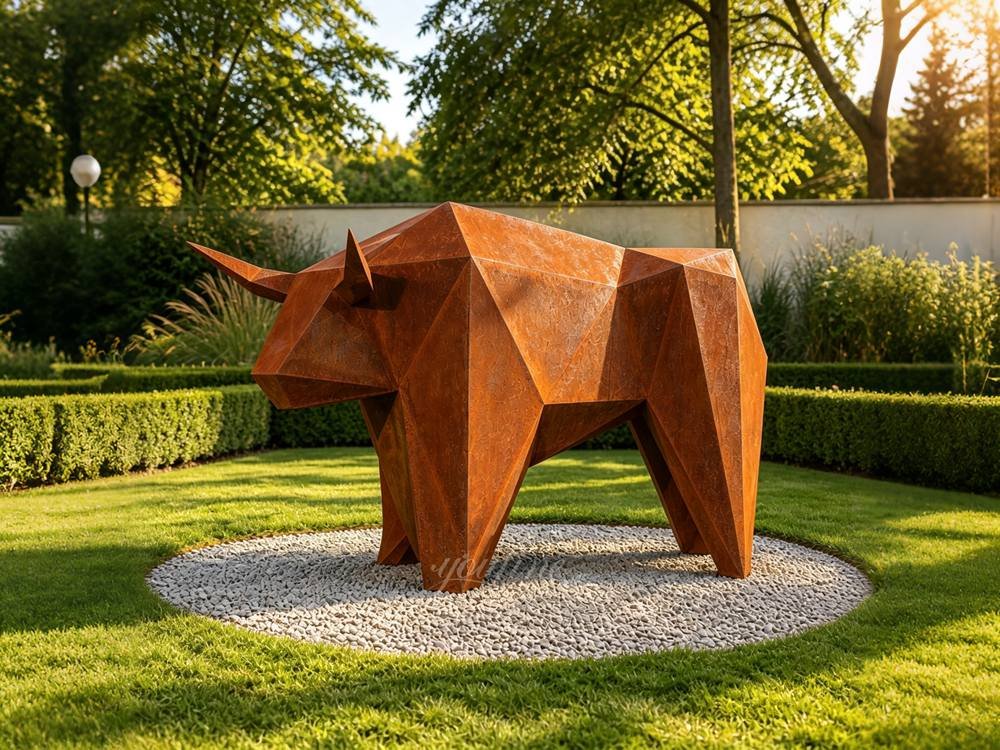
- Geometric, abstract, faceted forms — crisp lines and a strong sense of design. They suit modern minimal landscapes, upscale commercial settings and campus public art. The simpler the form, the more the cutting accuracy and the joint work show.
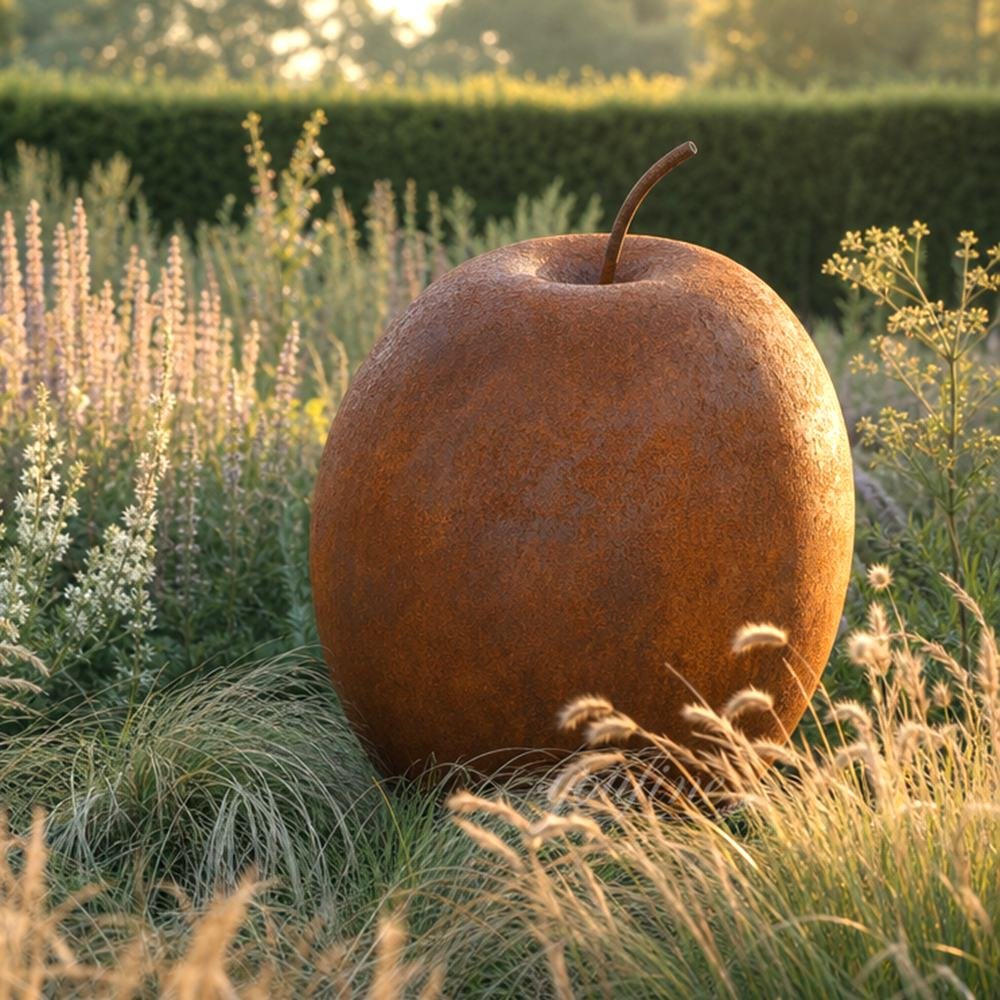
The rule of thumb: simple settings take simple forms; natural gardens take warm, organic ones.
| Direction | Character | Suits |
|---|---|---|
| Natural, organic (fruit, curves, natural pieces) | Warm, nostalgic, unhurried | English gardens, naturalistic planting, private courtyards |
| Geometric, abstract, faceted | Crisp, contemporary, considered | Modern minimal landscapes, upscale commercial settings, campus public art |
Craftsmanship and Quality: What Decides Both Looks and Lifespan
Two corten sculptures can look alike and last very different lengths of time. It comes down to craft details — and this is where most mistakes happen.
Material and plate thickness
- Check the material first. Genuine corten contains small amounts of copper, chromium and nickel, which is what allows a tight, well-bonded rust layer to form. Imitations made from ordinary carbon steel that has been rusted to look the part will keep corroding and thinning instead of forming a stable layer (YardSteel Australia). The check is simple: ask for the grade and the material certificate. (COR-TEN® is a registered trademark of United States Steel Corporation; “corten” is now the everyday name for this family of steel.)
- Then check the thickness. Thin plate is soft, and outdoors it bends, warps, and sags over time — this is the usual reason a piece “changes shape after a few years”. Always specify full thickness for outdoor work.
These figures come from IOTA’s long-term observation of how corten steel corrodes. The same source gives a measured example: in central London, corten loses around 0.8 mm over 40 years, and around 2.0 mm over 120 years (IOTA / External Works Index). In normal conditions, the material loss is very slow.
Welding
A corten sculpture is built from welded plate, and good work is not about invisible joins — it is about joins you cannot see:
- The filler metal needs to match the base metal (a low-alloy filler), so the weld has the same corrosion resistance and weathers to the same colour, instead of rusting first and unevenly (Hobart Brothers).
- After welding, the joints are carefully ground smooth, with slag, high spots and burrs removed, so the surface reads as one continuous form.
Surface treatment
A well-run pre-rusting process also fixes the loose rust particles in place after accelerating, which further reduces runoff once the piece is installed (Promisteel).
Base and structure
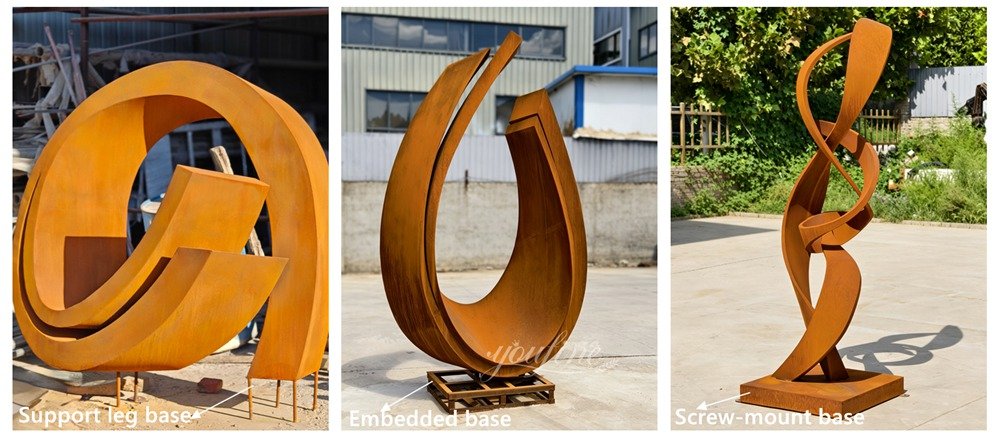
- The base should be fixed to a footing or embedded anchor, so the piece stands firm in wind and does not rock or topple.
- Check that the base-to-body connection is solid and the welds are clean.
- The underside should be flat and level, with extra bracing on larger pieces.
- Check that the base is in proportion to the body — a mismatched base makes a piece look top-heavy.
One caution: standing firm does not mean burying the corten in soil — in constant contact with soil or standing water, the rust layer never stabilises and corrosion speeds up instead.
After Installation: Site Preparation and Ongoing Care
This section is not part of the buying decision. It covers what happens before and after installation, and it is what makes the piece easy to live with.
Site preparation
- Prefer grass, soil or gravel. Runoff soaks away naturally and causes no visible problem.
- Avoid white or cream marble, pale permeable pavers and pale concrete. Once stained, they are very hard to clean.
- If the piece must sit on hard paving, use all three: raise the base on pads or a drainage mat; leave a 5–10 mm gap between base and ground so air can move; and lay a ring of dark gravel as a buffer.
- Keep the base ventilated and dry, away from low spots where water collects, so the rust layer does not become patchy.
- On hollow pieces, leave drainage holes in the internal cavity so water cannot sit inside.
- Watch where runoff will flow, and keep it away from pale walls.
Runoff, colour change and everyday care
Runoff is a phase, not a defect. On pieces that were not pre-rusted, it is mostly concentrated in the first 6–18 months and eases off as the dense rust layer forms. On pre-rusted pieces, most of it has already happened before delivery.
Colour change starts pale and slightly patchy, then deepens and evens out with sun and rain until it settles into a dense, dark brown patina — the longer it stays outside, the better it looks. How long that takes depends on climate: around 6–12 months in wet, rainy regions, roughly 12–24 months in temperate inland conditions, and 24–36 months or more in dry regions (BarrierBoss). This is natural ageing, not damage.
Everyday care is minimal. Inland gardens and parks need almost nothing beyond clearing dust and fallen leaves and keeping the base dry and ventilated. Do not paint, wax or lacquer it, and do not polish or de-rust it — all of these interfere with the patina. On coastal sites, rinse the surface with fresh water now and then to wash off salt. For more on outdoor sculpture care in general, see our guide to preserving outdoor sculptures.

In Summary
The order of priority when choosing: site and environment fit > scale and proportion > craftsmanship > shape.
The appeal of corten steel comes from what time does to it. Match the piece to the site, get the plate, welds and rust treatment right, prepare the ground properly, and keep the care simple — and it will sit happily in the landscape for decades, looking better with every season.
We match pieces to settings. Browse our full corten steel sculpture range to see different scales and forms together, or send us site photos or a plan, and we will build a scheme for your space — style direction, heights, placement and delivery.
Frequently Asked Questions
Will rust runoff pollute the environment or harm plants?
No. It is mainly iron oxide, which is not toxic, but it does stain pale hard paving, so plan the runoff path.
Can corten steel be used by the sea?
We would not recommend it. Salt air stops the protective rust layer from stabilising, so waterfront and near-coastal sites are best avoided; bronze or 316 stainless steel are better choices.
Will the sculpture keep bleeding rust forever?
No. On pieces that were not pre-rusted, it is mostly limited to the first 6–18 months; on pre-rusted pieces, most of it has already happened before delivery.
Does it need polishing or de-rusting?
No. Polishing damages the surface and disrupts the patina, leaving it patchy later. Just clear debris and keep it ventilated and dry.
Pre-rusted or naturally weathered — which should I choose?
If the schedule is tight and you want the finished look on day one, choose pre-rusted. If you would rather watch it change with the seasons, choose naturally weathered.